Scoliosis Treatment
Non-surgical management of scoliosis through chiropractic adjustments, targeted exercises, and postural correction for patients of all ages.
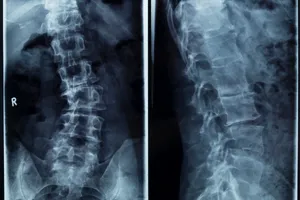
Scoliosis — an abnormal lateral curvature of the spine — affects an estimated six to nine million Americans. While the word often conjures images of dramatic S-shaped spines in medical textbooks, the reality for most scoliosis patients is subtler but no less impactful: a persistent asymmetry that produces uneven shoulders, an off-center rib cage, chronic back pain, and progressive postural deterioration if left unaddressed. At Georgia Injury Network in College Park, Dr. Daniel Dierdorff provides conservative, non-surgical scoliosis management that reduces pain, improves function, and slows or halts curve progression.
Understanding Scoliosis
A healthy spine, viewed from behind, forms a straight vertical line. Scoliosis occurs when the spine develops one or more lateral curves that measure 10 degrees or more on X-ray (the Cobb angle). These curves are three-dimensional — the vertebrae not only shift sideways but also rotate, which is what produces the characteristic rib prominence visible when a scoliosis patient bends forward.
Types of Scoliosis
Adolescent Idiopathic Scoliosis is the most common type, developing during the growth spurts of puberty in patients between 10 and 18 years old. “Idiopathic” means the cause is unknown, though genetic factors clearly play a role. Early detection and intervention during the growth years offers the best opportunity to influence curve progression.
Adult Degenerative Scoliosis develops in adults whose spines were previously straight. As intervertebral discs degenerate unevenly with age, and facet joints develop asymmetric arthritis, the spine gradually shifts into a lateral curve. This type of scoliosis is becoming increasingly prevalent as the population ages and is often accompanied by spinal stenosis and nerve compression.
Functional Scoliosis is a temporary curvature caused not by a structural deformity of the spine itself but by an external factor — a leg length discrepancy, muscle spasm, or pelvic misalignment that forces the spine into a compensatory curve. Correcting the underlying cause resolves the curvature.
Neuromuscular Scoliosis is associated with conditions such as cerebral palsy, muscular dystrophy, and spinal cord injury that impair the muscles’ ability to support the spine in a neutral position.
Signs and Symptoms
Mild scoliosis often goes unnoticed until a school screening, a routine physical, or a family member observes postural asymmetry. Common signs include:
- One shoulder sitting higher than the other
- An uneven waistline or hip height
- The head not centered over the pelvis
- One shoulder blade protruding more prominently
- The rib cage appearing more prominent on one side when bending forward
- Clothing hanging unevenly
- Back pain that worsens with prolonged sitting or standing
- Muscle fatigue on one side of the back
In adolescents, scoliosis is often painless in its early stages, which is why it frequently goes undetected until the curve has progressed. In adults, pain is typically the primary symptom, driven by the asymmetric loading of discs, joints, and muscles that the curvature creates.
Chiropractic Approach to Scoliosis
Dr. Dierdorff takes a structured, evidence-based approach to scoliosis management that addresses both the curve itself and the symptoms it produces.
Comprehensive Assessment
Every scoliosis patient receives a thorough postural analysis, spinal examination, and review of any existing imaging. When current X-rays are not available, they may be ordered to measure the Cobb angle, identify the apex of the curve, assess skeletal maturity in adolescent patients, and establish a baseline for monitoring progression.
Chiropractic Adjustments
Targeted adjustments address the vertebral misalignments and joint restrictions that accompany scoliotic curves. While adjustments alone will not eliminate a structural curve, they reduce pain, restore mobility to restricted segments, and improve the overall mechanics of the spine. For functional scoliosis, correcting pelvic misalignment and leg length inequality can resolve the compensatory curve entirely.
Scoliosis-Specific Exercise
Generic exercise programs are not sufficient for scoliosis management. Dr. Dierdorff prescribes exercises based on the specific curve pattern — exercises designed to elongate the concave side, strengthen the convex side, and de-rotate the vertebrae. These exercises, performed consistently, can slow or halt curve progression in growing adolescents and reduce pain and improve posture in adult patients.
Postural Training
Scoliosis patients often develop compensatory postural habits that worsen their curvature over time. Dr. Dierdorff teaches patients to recognize and correct these patterns throughout their daily activities — sitting, standing, sleeping, and exercising — replacing the habits that feed the curve with those that counteract it.
Why Early Intervention Matters
For adolescent patients in the College Park area, early detection and intervention can make the difference between a mild curve that is easily managed and a severe curve that requires bracing or surgery. Curves progress most rapidly during growth spurts, and once skeletal maturity is reached, the opportunity to influence curve behavior through conservative means diminishes significantly.
For adult patients, early intervention prevents the progressive pain, functional limitation, and postural deterioration that untreated degenerative scoliosis inevitably produces. The sooner treatment begins, the more effectively it can slow degeneration and maintain quality of life.
Get an Assessment
Whether you are a parent concerned about your child’s posture or an adult experiencing back pain from a known or suspected spinal curvature, Georgia Injury Network can help. Call (470) 397-1527 or schedule your evaluation online. Dr. Dierdorff serves scoliosis patients throughout College Park, Union City, Fairburn, and the south Atlanta metro area.
Ready to Get Started?
Contact us today and take the first step. Free consultations available.