Sciatica Treatment
Relief from sciatic nerve pain, leg numbness, and shooting pain caused by disc herniation, piriformis syndrome, or spinal stenosis.
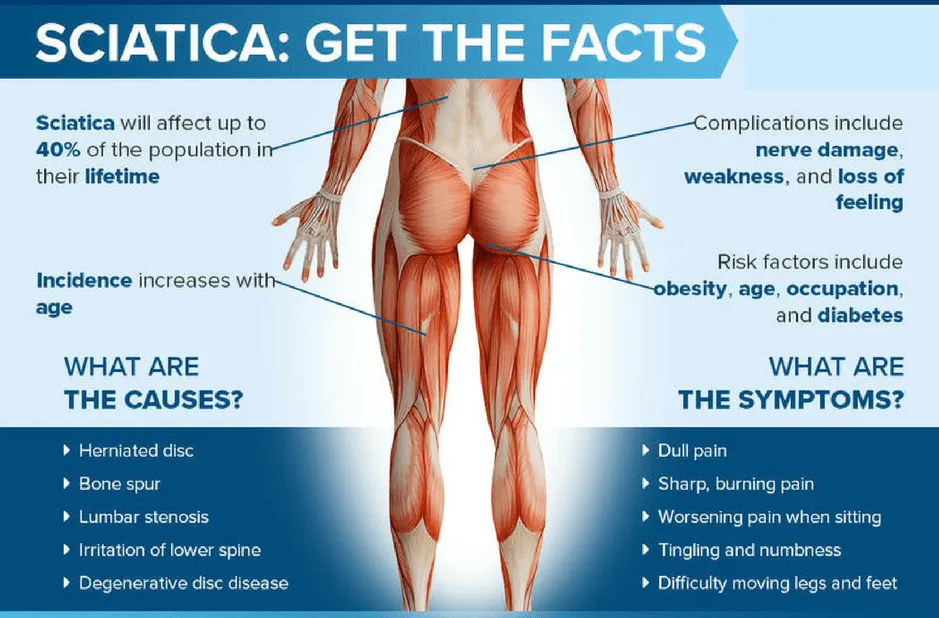
The sciatic nerve is the longest and thickest nerve in the human body, running from the lower back through the buttock and down the entire length of each leg. When this nerve is compressed, irritated, or inflamed, the result is sciatica — a condition that produces pain so distinctive that patients can usually trace its path with a finger from their lower back to their foot. At Georgia Injury Network, Dr. Daniel Dierdorff treats the structural causes of sciatica, providing lasting relief for College Park patients who have been told their only options are pain pills or surgery.
What Sciatica Feels Like
Sciatica is not a subtle condition. The hallmark symptom is a sharp, burning, or electric-shock-like pain that radiates from the lower back or buttock down the back of the thigh and into the calf or foot. Unlike a general ache, sciatic pain follows a specific nerve pathway that corresponds to the location of the nerve compression.
Patients at our College Park clinic describe a range of accompanying symptoms:
- A deep, burning pain in one buttock that intensifies when sitting
- Sharp, shooting pain that makes standing from a seated position excruciating
- Numbness or a “pins and needles” sensation in the leg or foot
- Weakness in the affected leg, causing the foot to drag or the knee to buckle
- Pain that worsens with coughing, sneezing, or bearing down
- A constant ache on one side of the lower back that never fully lets up
Sciatica almost always affects only one side of the body. Bilateral sciatica — pain in both legs simultaneously — is less common and may indicate a more serious condition such as cauda equina syndrome, which requires immediate medical attention.
The Root Causes of Sciatica
Sciatica is a symptom, not a diagnosis. The sciatic nerve pain is always caused by something compressing or irritating the nerve at some point along its path. Identifying that cause is the key to effective treatment.
Lumbar Disc Herniation
The most common cause of sciatica is a herniated disc in the L4-L5 or L5-S1 segments of the lumbar spine. When disc material protrudes through a tear in the outer ring and contacts the sciatic nerve root, it triggers inflammation and pain that radiates along the nerve’s entire distribution. The chemical irritation from the disc material is often more painful than the mechanical pressure alone.
Piriformis Syndrome
The piriformis is a small, deep muscle in the buttock that the sciatic nerve passes beneath — or in about 15% of the population, passes directly through. When the piriformis muscle becomes tight, inflamed, or goes into spasm, it can compress the sciatic nerve and reproduce all the symptoms of a disc-related sciatica. Piriformis syndrome is frequently misdiagnosed and often develops in people who sit for extended periods, which makes it particularly common among College Park commuters and office workers.
Spinal Stenosis
Narrowing of the spinal canal or the neural foramina (the openings through which nerve roots exit the spine) can compress the sciatic nerve roots. Stenosis-related sciatica is more common in patients over 50 and typically worsens with standing and walking while improving with sitting or bending forward.
Sacroiliac Joint Dysfunction
When the sacroiliac joint — where the base of the spine meets the pelvis — becomes misaligned or inflamed, it can refer pain into the buttock and down the leg in a pattern that mimics true sciatica. SI joint dysfunction is a frequently overlooked cause of sciatic-type symptoms, particularly in patients who have already undergone lumbar imaging that shows no disc pathology.
How Dr. Dierdorff Treats Sciatica
Effective sciatica treatment starts with accurate diagnosis. Dr. Dierdorff performs specific orthopedic and neurological tests — including the straight leg raise, slump test, and crossed straight leg raise — to determine whether the sciatic nerve is being compressed by a disc, a muscle, a joint, or bony narrowing. This distinction determines the treatment approach.
For Disc-Related Sciatica
Chiropractic adjustments realign the lumbar vertebrae, reducing the uneven loading that pushes disc material against the nerve root. Flexion-distraction technique creates a gentle pumping action that draws herniated disc material away from the nerve, reducing both mechanical pressure and chemical inflammation. Most patients experience significant pain reduction within the first two to four weeks of treatment.
For Piriformis-Related Sciatica
When the piriformis muscle is the culprit, treatment focuses on releasing the spasm through deep tissue techniques, targeted stretching, and exercises that strengthen the hip external rotators to prevent recurrence. Pelvic adjustments correct any underlying SI joint dysfunction that may be contributing to piriformis overactivity.
For Stenosis-Related Sciatica
Chiropractic care for spinal stenosis focuses on maximizing the available space in the spinal canal through distraction-based techniques and exercises that promote lumbar flexion. While the stenosis itself is a structural change that cannot be reversed through manual therapy, the symptoms can be effectively managed, and many patients avoid surgical intervention entirely.
Stop Living Around the Pain
Sciatica forces people to change how they sit, how they stand, how they drive, and how they sleep. It limits activity, disrupts work, and steals quality of life. If you are experiencing sciatic nerve pain in College Park, East Point, Riverdale, or the surrounding communities, contact Georgia Injury Network at (470) 397-1527 or book your appointment online. Dr. Dierdorff will identify the cause of your sciatica and build a treatment plan to resolve it.
Ready to Get Started?
Contact us today and take the first step. Free consultations available.